This first video shows an octopus squeezing its body through a one-inch hole. Amazing what can be done when you're an invertebrate!
The next video was taken at an aquarium. Scientists there were confused as to why shark carcasses kept showing up at the bottom of the tank, so they stayed up late one night to learn something surprising and new about the culprit!
Monday, December 04, 2006


Sunday, December 03, 2006
LEDs to start replacing light bulbs soon
 Experts say that light-emitting diodes will become economically viable as replacements for conventional light bulbs in about two years, which could lead to massive conservation of electricity.
Light-emitting diodes, or LEDs, last about 100,000 hours, which is far longer than conventional filament bulbs. Unfortunately, the LEDs that can do this currently cost about $60. But prices have been declining by 50% a year, so two years from now the same LED should cost around $20.
Approximately 22% of the electricity consumed in the United States goes toward lighting, according to the U.S. Department of Energy. Conventional light bulbs are incredibly inefficient. Only about 5% of the energy that goes into them turns into light. The majority gets dissipated as heat.
If 25% of the light bulbs in the U.S. were converted to LEDs, the U.S. as a whole could save $115 billion in utility costs, cumulatively, by 2025, and it would alleviate the need to build 133 new coal-burning power stations. In turn, carbon emissions in the atmosphere would go down by 258 metric tons.
Saturday, December 02, 2006
Bogs
 A bog is a type of wetland that accumulates acidic peat, which is a deposit of dead plant material. Bogs are widely distributed in cold, temperate climes, mostly in the northern hemisphere. Some of the world's largest wetlands are the bogs of the Western Siberian Lowlands in Russia. Many bogs are also found in Europe, including Ireland, Scotland, the Netherlands, Sweden, Estonia, Finland, and northern Germany. They are also found in Canada and Alaska.
One of the interesting aspects of bogs is their ability to preserve organic material. This aspect has given rise to the term "bog bodies," as more than a thousand preserved human bodies have been found in bogs. These bodies have been dated as far back as 10,000 BC. Click here for Slate's "Explainer" podcast on how bogs are able to preserve organic material so well.
 One of the most famous bog bodies is that of "Tollund Man" (pictured on the right). Radiocarbon dating has placed his death at approximately 350 BC, yet you can still clearly see is face and the rope around his neck that killed him. The man's stomach and intestines were also intact, and scientists discovered that his last meal had been a kind of soup made from vegetables and seeds, some cultivated and some wild: barley, linseed, gold of pleasure (Camelina sativa), knotweed, bristlegrass, and camomile.
Thursday, November 30, 2006
More Wildlife Photo Winners
Below are some photos from National Geographic's "Best Wildlife Photos" for 2006.
In this picture, the turtle is getting a full-body cleaning and massage from the fish at Turtle Pinnacle near Kailua Kona, Hawaii. The photographer noted that turtles that come there rarely have to wait long for such a treatment from the fish, though some get more attention than others depending on how much algae they have on them. The algae-eaters are colorful yellow tang and goldring surgeonfish, a species found only around the Hawaiian Islands. Also indigenous to the region is the saddleback wrasse, seen underneath, which feeds on dead and damaged skin.

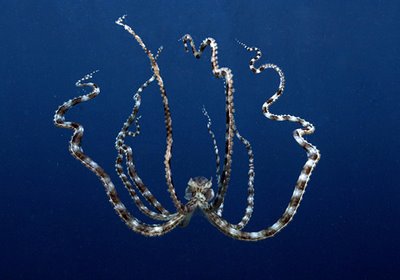
The below picture features the rare Indo-Malayan mimic octopus, a species that was first described only a year ago. The mimic octopus is a master of disguise. When the photographer first saw the octopus, it was pretending to be an eel. As he swam along with it, he saw it go on to assume the appearance of a sole, a ray, and then a sea snake. Its "repertoire" of disguises are used for both hunting and hiding, and also include such shapes as hermit crabs, jellyfish, and sea cucumbers. In the picture, the 1.5-foot-long octopus is mimicking a feather star, an animal related to the sea star, or starfish.
In this picture, the turtle is getting a full-body cleaning and massage from the fish at Turtle Pinnacle near Kailua Kona, Hawaii. The photographer noted that turtles that come there rarely have to wait long for such a treatment from the fish, though some get more attention than others depending on how much algae they have on them. The algae-eaters are colorful yellow tang and goldring surgeonfish, a species found only around the Hawaiian Islands. Also indigenous to the region is the saddleback wrasse, seen underneath, which feeds on dead and damaged skin.

The below picture features the rare Indo-Malayan mimic octopus, a species that was first described only a year ago. The mimic octopus is a master of disguise. When the photographer first saw the octopus, it was pretending to be an eel. As he swam along with it, he saw it go on to assume the appearance of a sole, a ray, and then a sea snake. Its "repertoire" of disguises are used for both hunting and hiding, and also include such shapes as hermit crabs, jellyfish, and sea cucumbers. In the picture, the 1.5-foot-long octopus is mimicking a feather star, an animal related to the sea star, or starfish.
Tuesday, November 28, 2006
Grow your own Luffa sponge!
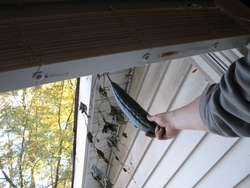
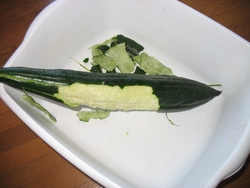
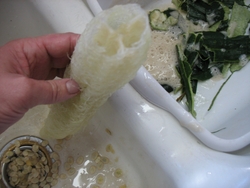
Check out this how-to article on growing your own Luffa sponge. Below are some of the pictures from the article:
NWF Photo Contest
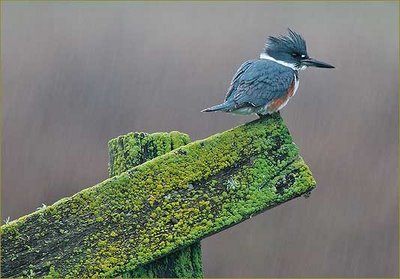
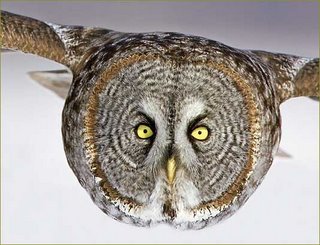
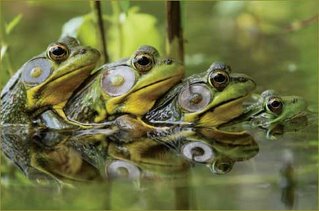
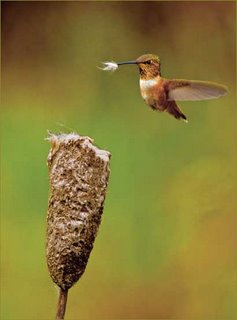
Below are some pictures from the National Wildlife photo contest. The picture of the owl was the winner, and was taken right before the photographer ducked out of the way.


Why are Venus flytraps so fast?

 A team of scientists and engineers has discovered how the carnivorous Venus flytrap is able to close its leaves around an insect in 0.04 seconds.
Unlike animals, plants have no muscles or brains and are not known for their ability to move quickly. However, the secret has been revealed: The flytrap's leaves snap from convex to concave the same way that a contact lens can flip inside out.
The team cut up leaves to study their natural curls, and also painted fluorescent dots on intact leaves to track their insect-devouring action with high-speed cameras. Like most lenses, Venus flytrap leaves are doubly curved, that is, curved in two directions, which allows the leaves to store elastic energy.
The question of what initiates the snap buckling remains unanswered. It starts when stiff hairs on the leaves’ edges are touched. Scientists suspect some high-pressure movement of water through the leaves makes them start to curl in a way that initiates the snap buckling.
Monday, November 27, 2006
Humpback whales have 'human' brain cells
 Humpback whales have been found to have a type of brain cell seen only in humans, the great apes, and other cetaceans such as dolphins.
This might mean such whales are more intelligent than they have been given credit for, and suggests the basis for complex brains either evolved more than once, or has gone unused by most species of animals.
The finding may help explain some of the behaviors seen in whales, such as intricate communication skills, the formation of alliances, cooperation, cultural transmission and tool usage.
Thursday, November 23, 2006
Are fish stupid?
 Contrary to the popular assumption that fish are stupid, scientists have discovered that they are actually adept learners, with distinct personalities that change as they pick up information about the world.
The study found that rainbow trout (Oncorhynchus mykiss) remember experiences so well that they alter their behavior in line with what they learn, and that they have contrasting personalities. Some are bold and some are shy. The bold fish take risks, they are quick to learn, more aggressive and active. Shy fish are cautious and timid, and spend more time under cover.
Monday, November 20, 2006
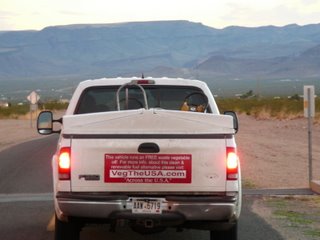
7,500 Miles On $5 In Gas, Veggie Oil
A high school student in Atlanta named Bill Bridgers has converted his diesel pickup truck to run almost exclusively on used vegetable oil. He has been driving across the country with his father and a friend, informing people about alternative fuel possibilities along the way. He is chronicling his journey at VegTheUsa.com.
Bridgers uses a large filter to get food particles and impurities out of the oil, which is then heated to 180 degrees and pumped into the truck's engine. He says he has lots of friends in the restaurant business who give him their used oil, which is just a waste product to them. Gasoline is only used when the truck is first turned on, then just before it's turned off.
So far Bridgers says he and his companions have driven 7,500 miles and spent just $5 on gas. The rest of the time, his truck has been running on the vegetable oil.
Bridgers uses a large filter to get food particles and impurities out of the oil, which is then heated to 180 degrees and pumped into the truck's engine. He says he has lots of friends in the restaurant business who give him their used oil, which is just a waste product to them. Gasoline is only used when the truck is first turned on, then just before it's turned off.
So far Bridgers says he and his companions have driven 7,500 miles and spent just $5 on gas. The rest of the time, his truck has been running on the vegetable oil.

Subscribe to:
Posts (Atom)

 Posts

