Showing posts with label technology. Show all posts

Monday, September 07, 2009

Google Algorithm Predicts When Species Will Go Extinct


Biologists have figured out the most efficient way to destroy an ecosystem — and it’s based on the Google search algorithm.

Scientists have long known that the extinction of key species in a food web can cause collapse of the entire system, but the vast number of interactions between species makes it difficult to guess which animals and plants are the most important.

Now, computational biologists have adapted the Google search algorithm, called PageRank, to the problem of predicting ecological collapse, and they’ve created a startlingly accurate model.

Using a modified version of PageRank, the researchers were able to identify which species extinctions within a food web would lead to biggest chain-reaction of species death.

Unlike previous solutions to the coextinction problem, the Google solution takes into account not only the number of connections between species, but also their relative importance. In other words, grass is important because it’s eaten by gazelles, and gazelles are important because they’re eaten by lions.

The scientists have found that the importance of a species can be connected to the amount of matter that flows to it. If species eat a lot of things, and a lot of things eat them, they tend to be important. Previous solutions to the problem tended to underestimate the importance of species that are lower on the food chain, and hopes are that the new solution will encourage conservation biologists to take a broader view of species extinctions.

Original article here.

Thursday, March 12, 2009

Microscopic Images from Inside the Human Body

Below are a few samples from this neat gallery of microsopic images from inside the human body.

Almost all of the images were captured using a scanning electron microscope (SEM), a type of electron microscope that uses a beam of high-energy electrons to scan surfaces of images. The electron beam of the SEM interacts with atoms near or at the surface of the sample to be viewed, resulting in a very high-resolution, 3D-image. Magnification levels range from x 25 (about the same as a hand lens) to about x 250,000. Incredible details of 1 to 5 nm in size can be detected.

To read more about the images and see additional examples, click here.

Split end of human hair:


Hair cell in the ear:


Tongue with taste bud:


Lung cancer cells:


Villi of small intestine:


Colored image of a 6 day old human embryo implanting:


See the rest, along with additional info here.

Thursday, December 18, 2008

Video of Molecules Moving in Living Cells


A new microscopic imaging technique has provided what may be the most realistic real-time video yet of molecules moving in living cells.

Called Stimulated Raman Scattering, it uses laser beams to hit molecules, causing them to vibrate. Tracking the vibrations produces a sequence of point-by-point molecular maps.

Examples of practical applications include companies making skin care products who can use the SRS technique to see how different ingredients of their formulations distribute and diffuse in skin, or the food industry mapping distributions of fats, proteins and sugars in food products. It will eventually be used for tumor diagnostics in hospital as well.

The video shows fat molecules (bright yellow perimeter) at different depths in mouse skin.

Original article here.

Tuesday, October 23, 2007

Virtual Microscope

The Virtual Microscope is a cool software program that provides simulated scientific instrumentation.

The Virtual Microscope supports functionality from electron, light, and scanning probe microscopes, datasets for these instruments, training materials to learn more about microscopy, and other related tools. There are currently 90 samples totaling over 62 gigapixels of image data. It includes everything from Meteorites to Pond Scum to a Firefly!

You can download the program for FREE by clicking here (scroll to "Installers for Windows and Mac"). Once you have installed and opened the program, you can directly select from the many samples. Try adjusting the "Magnification" and "Opacity" controls to see some great detail!

Below is a screen shot of sand from Costa Rica at 1800x magnification:

Tuesday, March 27, 2007

Elephant Ultrasound

CNN has an interesting video of zookeepers at the Pittsburgh Zoo using ultrasound to monitor the pregnancies of elephants.

Friday, February 23, 2007

X-ray Videos Show Animal Skeletons in Motion

Scientists are filming animals as they run on treadmills (or fly in wind tunnels) and then using a new 3-D video technique to peek beneath the skin with X-Rays to see the skeletons on the move. The final process of making the movies is still in the design phase, but some scaled down and simplified versions are already available (see a movie of a pig walking).

The scientists are using this approach to understand how the biomechanics of flight evolved. To trace flight back in time, they made skeletal movies of alligators—the closest living relatives of birds—as they walked along a moving treadmill.

Another recent study discovered a flight-helping ligament that transformed as winged birds evolved. Now, the scientists are preparing to study birds as they toddle up steep inclines while flapping their wings. By comparing the skeletal movies from the walking birds with those in flight, the scientists expect learn other key features needed for flight.


The technique will also breathe life into fossil bones from extinct animals like theropod dinosaurs. Three-dimensional images of the brittle bones can be fitted with moving skeletons from modern-day relatives.

Other future uses of the technology could include:

* Measuring the forces applied to each joint as a person runs or a frog jumps.
* Testing new theories of biomechanics, such as muscle-tendon interactions.
* Studying the evolution of joints, from the cartilaginous joints in most mammals to the “more advanced” joints in humans, which are bonier.
* Planning orthopedic surgeries and comparing the effectiveness of different approaches.
* Creating better treatments for shoulder, wrist, knee and back injuries.

In a related article, see this video of a shrimp on a treadmill.

Sunday, December 03, 2006

LEDs to start replacing light bulbs soon

Experts say that light-emitting diodes will become economically viable as replacements for conventional light bulbs in about two years, which could lead to massive conservation of electricity.

Light-emitting diodes, or LEDs, last about 100,000 hours, which is far longer than conventional filament bulbs. Unfortunately, the LEDs that can do this currently cost about $60. But prices have been declining by 50% a year, so two years from now the same LED should cost around $20.

Approximately 22% of the electricity consumed in the United States goes toward lighting, according to the U.S. Department of Energy. Conventional light bulbs are incredibly inefficient. Only about 5% of the energy that goes into them turns into light. The majority gets dissipated as heat.

If 25% of the light bulbs in the U.S. were converted to LEDs, the U.S. as a whole could save $115 billion in utility costs, cumulatively, by 2025, and it would alleviate the need to build 133 new coal-burning power stations. In turn, carbon emissions in the atmosphere would go down by 258 metric tons.

Monday, November 20, 2006

7,500 Miles On $5 In Gas, Veggie Oil

A high school student in Atlanta named Bill Bridgers has converted his diesel pickup truck to run almost exclusively on used vegetable oil. He has been driving across the country with his father and a friend, informing people about alternative fuel possibilities along the way. He is chronicling his journey at VegTheUsa.com.

Bridgers uses a large filter to get food particles and impurities out of the oil, which is then heated to 180 degrees and pumped into the truck's engine. He says he has lots of friends in the restaurant business who give him their used oil, which is just a waste product to them. Gasoline is only used when the truck is first turned on, then just before it's turned off.

So far Bridgers says he and his companions have driven 7,500 miles and spent just $5 on gas. The rest of the time, his truck has been running on the vegetable oil.


Wednesday, September 06, 2006

Ultra-Energy-Efficient House

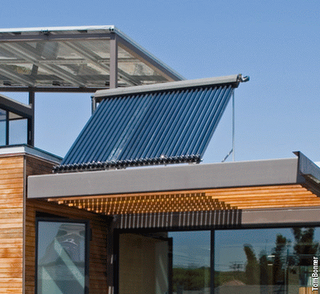
BusinessWeek has an article on an ultra-energy-efficient house in Santa Monica, CA which is the first home in the country to be given "platinum" status in the U.S. Green Building Council's LEED rating system (for Leadership in Energy and Environmental Design).

Some of the neat, energy-saving features of this environmentally-friendly house include:

- Living Roof: A garden of deer grass and other native plants will help insulate the house, keeping it cooler in the summer and retaining heat in the winter.

- Hot Water: A panel of glass tubes is positioned on the roof. Water pumped through the tubes is heated by the sun and stored in an insulated tank for use in showers and sinks. Hot water is also circulated through a series of plastic tubes embedded in the house's floors. This radiant heating system is more energy-efficient than forced air and doesn't spread pollen, dust, or germs.

- Recycled Water: Rainwater collected from the roof and yard is stored in a cistern buried under the house. So-called "gray water" from the sinks and showers is run through an underground filtration system consisting of asphalt, rock, and soil. Both sources are used to water the rooftop garden and grounds.

Be sure to check out the accompanying graphic and slideshow!