Wired magazine recently ran an article focusing on invasive species. The article was prompted by reports of the U.S. Navy "bombing" Guam with dead, drugged mice in an effort to kill off the invasive Brown tree snake (shown below). Interesting!
Brown tree snake:
Kudzu:
Northern Snakehead:
Asian carp:
See more in the original article here.
Showing posts with label plant life. Show all posts
Thursday, November 04, 2010
Monday, October 18, 2010
Island of plastic drink bottles and foam installed at Hoover Alabama's Veterans Park
Crews from the city of Hoover launched and anchored manmade floating island in the lake at Veteran's Park. The 480-square-foot island is made by Floating Island Environmental Solutions of Baton Rouge, La., and is constructed out of recycled plastic drinking bottles, bouyant marine foam, PVC pipe and stainless steel cables and connectors. There are 12 modules that make up the entire island with pre-drilled holes allowing the root ball of the plants to reach the water underneath requiring no chemical fertilization.
See more pictures at the original article here.
Tuesday, August 11, 2009
Giant carnivorous plant found
In a coincidental follow-up to yesterday's post, a new species of giant carnivorous plant has been discovered in the highlands of the central Philippines.The pitcher plant is among the largest of all pitchers and is so big that it can catch rats as well as insects in its leafy trap. Botanists have named the pitcher plant after British natural history broadcaster David Attenborough (Nepenthes attenboroughii).
Pitcher plants are carnivorous. Carnivorous plants come in many forms, and are known to have independently evolved at least six separate times. While some have sticky surfaces that act like flypaper, others like the Venus fly trap are snap traps, closing their leaves around their prey.
Pitchers create tube-like leaf structures into which insects and other small animals tumble and become trapped.
The pitcher plant does not appear to grow in large numbers, but McPherson hopes the remote, inaccessible mountain-top location, which has only been climbed a handful of times, will help prevent poachers from reaching it.During the expedition, the team also encountered another pitcher, Nepenthes deaniana, which had not been seen in the wild for 100 years. The only known existing specimens of the species were lost in a herbarium fire in 1945.
On the way down the mountain, the team also came across a striking new species of sundew, a type of sticky trap plant, which they are in the process of formally describing. Thought to be a member of the genus Drosera, the sundew produces striking large, semi-erect leaves which form a globe of blood red foliage.
Original article here.
Monday, August 10, 2009
Tiny Ecosystems in Bowels of Carnivorous Plants

For insight into complex ecological dynamics, one Harvard University biologist peers into the cupped leaves of carnivorous pitcher plants.
At the bottom of each slippery-sided leaf is a pool of water into which unlucky insects fall and drown. The bugs sustain not only the plant, but an intricate food web of bacteria, plankton and invertebrates. Each pool is small enough to fit in a shot glass, and big enough to model the world.
According to the scientist, each leaf is its own "individual lake, its own individual ecosystem. Suddenly, in a bog I can walk to from my office, I’ve got 50,000 lakes to do experiments on. This is an opportunity to understand how a complete, functioning natural ecosystem works.”Understanding how ecosystems work is an important but challenging task for scientists. Though patterns can be described — nutrient levels shift, an animal population grows, another shrinks — it can be hard to know what’s coincidental and what’s linked.
If researchers can run experiments on an ecosystem, measuring exactly what goes in and out, tweaking different aspects and seeing what happens, then they can better decipher its underlying rules.
However, it’s not easy to replicate nature. Ecologists have had some success studying islands and lakes, which are fairly self-contained, and extrapolating those findings to the rest of the natural world.
For the last fifteen years, scientists slogged through the bogs of New England, studying the life that exists in each pool. At the very base are bacteria, which support phytoplankton and cytoplankton, which support single-celled animals, which support fly larvae. All of it relies on nutrients delivered by drowning bugs.
There are four or five trophic levels in a pitcher plant, just like there are four or five trophic levels in a lake.
Fly larvae are the top-level predator in the pitcher, the analogues of tigers or wolves. They’re what ecologists call a “keystone” species, who control the abundance every other species, but require a habitat of sufficient size to support those other creatures.
Original article here.
Friday, July 10, 2009
“Self-Irrigating” Desert Plant Discovered

A desert plant has apparently figured out how to water itself.
Ecologists had been puzzling over the desert rhubarb for years: Instead of the tiny, spiky leaves found on most desert plants, this rare rhubarb boasts lush green leaves up to a meter wide. Now scientists have discovered that ridges in the plant’s giant leaves actually collect water and channel it down to the plant’s root system, harvesting up to 16 times more water than any other plant in the region. It is the online known case of a self-irrigating plant.
The desert rhubarb grows in the mountainous deserts of Israel and Jordan, where there’s only about 75mm of rainfall each year. Even during the rainy season, the region’s light rainfalls often don’t penetrate the rocky soil of the desert. Plants with large leaves and a deep root system, like the desert rhubarb, typically can’t survive in such an arid climate.But when the researchers measured the plant’s water absorption during a light rain, they discovered that water infiltrated the soil 10 times deeper around the desert rhubarb then in surrounding areas. Upon closer examination, scientists discovered deep grooves around the plant’s veins, which are coated in a waxy cuticle that helps channel water down to the root.
Original article here.
Sunday, December 21, 2008
Mekong Delta "Treasure Trove" of New Species
A rat believed to be extinct for 11 million years, a spider with a foot-long legspan, and a hot pink cyanide-producing "dragon millipede" are among the thousand newly discovered species in the largely unexplored Mekong Delta region.
The region, including parts of Vietnam and five other countries, is home to 1,068 species found between 1997 and 2007, according to the World Wildlife Fund. The organization's report "First Contact in the Greater Mekong" (PDF) says 519 plants, 279 fish, 88 frogs, 88 spiders, 46 lizards, 22 snakes, 15 mammals, four birds, four turtles, two salamanders and a toad were found.
Some of the creatures were not lurking in fertile floodplains or tropical foliage. A scientist visiting an outdoor restaurant was startled to see a Laotian rock rat among the nearby wildlife. The hairy, nocturnal, thick-tailed rat, which resembles a squirrel, had been thought for centuries to be extinct.
Perhaps a more startling discovery than the rat was a bright green pit viper scientists spotted slithering through the rafters of a restaurant in Khao Yai National Park in Thailand.
Below are several pictures of the creatures taken from this CNN photo gallery. See also this video from CNN discussing the discoveries. At the top of the post is a Youtube video from the WWF introducing the discoveries.


Labels:
amphibians,
animals,
mammals,
new discoveries,
plant life,
reptiles
Sunday, June 15, 2008
2000 year-old seed germinated

Three years ago, a team of researchers took an ancient date seed collected from one of King Herod's palaces and planted it in a small pot. It sprouted, and Methuselah, as they dubbed the sapling, is now 5 feet high.
Radiocarbon dating shows the seed was 2,000 years old, by far the oldest ever to have germinated, as reported in the journal Science. The researchers say they hope the plant will help resurrect a long-extinct species known in biblical times for the sweetness of its fruit.
It is also special because of where it was found: Masada, a mountaintop fortress overlooking the Dead Sea, is where Jewish forces made their last stand against Roman troops after the fall of Jerusalem in the year 70.
A number of seeds were collected in the early 1960s by archaeologists excavating the fortress. They stored the seeds at room temperature for nearly four decades. They didn't just plop the seeds into a pot. Instead, they bathed three seeds in fertilizer and enzyme-rich solutions before they were planted. Two of them came up. The plant appears normal, although some of its early leaves had white patches on them. It won't be known whether it will bear fruit until about 2010.
The date palm was domesticated more than 5,000 years ago, and the Judean Dead Sea region was famous for its high-quality fruit. Ancient texts describe how the dates were used to treat tuberculosis, heart problems, worms and infections.
Thursday, May 03, 2007
World's largest fossil forest found in Illinois coal mine
Illinois geologists have discovered the remains of one of the world's oldest tropical rainforests, preserved in the ceiling of a coal mine 250 feet below the surface. The fossil forest encompasses four square miles, which is the largest find ever.
Plant fossils are common in coal beds, as coal is the compacted result of peaty plant material. But scientists are surprised by the size of this fossil bed, which they suspect came about because of a freak event: an earthquake that flooded and buried the forest. The vast extent of the fossil forest, which existed in a swampy time of giant dragonflies and tree ferns, has allowed the scientists to infer subtle ecological changes across the ancient landscape.
These are the remnants of extinct plants from a geological period 300 million years ago, called the Carboniferous, when the world was covered in a riot of green. Illinois was near the equator and much warmer and wetter. It was also a time before flowering plants had evolved, and so the plants would seem bizarre to modern eyes.
Giant tree ferns would have formed a lower canopy 30 feet high. Poking up through the ferns would have been 100-foot-tall clubmosses — asparagus-like poles that sprouted crowns full of spores. It was the age of insects, with 6-foot-long millipedes and dragonflies with yard-long wingspans.
When the ancient earthquake hit, a sudden flooding in the submerged block killed the rainforest. Mud and silt rushed into the depression, preserving the stumps and logs in a layer that eventually became shale.

Labels:
earth science,
fossils,
new discoveries,
plant life
Friday, April 13, 2007
Study Suggests Earth was Purple
The earliest life on Earth might have been just as purple as it is green today, a scientist claims. Ancient microbes might have used a molecule other than chlorophyll to harness the Sun’s rays, one that gave the organisms a violet hue.Chlorophyll, the main photosynthetic pigment of plants, absorbs mainly blue and red wavelengths from the Sun and reflects green ones, and it is this reflected light that gives plants their leafy color.
According to the scientist, chlorophyll appeared after another light-sensitive molecule called retinal was already present on early Earth. Retinal, today found in the plum-colored membrane of a photosynthetic microbe called halobacteria, absorbs green light and reflects back red and violet light, the combination of which appears purple.
Primitive microbes that used retinal to harness the sun’s energy might have dominated early Earth, thus tinting some of the first biological hotspots on the planet a distinctive purple color.
Tuesday, November 28, 2006
Why are Venus flytraps so fast?

A team of scientists and engineers has discovered how the carnivorous Venus flytrap is able to close its leaves around an insect in 0.04 seconds.Unlike animals, plants have no muscles or brains and are not known for their ability to move quickly. However, the secret has been revealed: The flytrap's leaves snap from convex to concave the same way that a contact lens can flip inside out.
The team cut up leaves to study their natural curls, and also painted fluorescent dots on intact leaves to track their insect-devouring action with high-speed cameras. Like most lenses, Venus flytrap leaves are doubly curved, that is, curved in two directions, which allows the leaves to store elastic energy.
The question of what initiates the snap buckling remains unanswered. It starts when stiff hairs on the leaves’ edges are touched. Scientists suspect some high-pressure movement of water through the leaves makes them start to curl in a way that initiates the snap buckling.
Tuesday, November 07, 2006
What Tree is That?
Most trees can be identified by studying their leaves, seeds, and fruit. This website contains a glossary of tree terms, as well as a flash animation that will help you learn to identify these characteristics and take a step-by-step approach to arrive at the name of your tree.
Thursday, September 21, 2006
Seeds 200 years old breathe again!
The BBC reports that some seeds which have been stored away since the time of King George III have been brought to life. Scientists from the Millennium Seed Bank, operated by the Royal Botanic Gardens at Kew (near London), have induced seeds from three species to germinate. They had been brought to Britain from South Africa by a Dutch merchant in 1803, and were found in a notebook stored in the British National Archives.The three successes are a legume, Liparia villosa, and two species not yet identified, one a protea and the other an acacia (pictured on the right).
When the plants are older, the scientists plan to compare the old plants with modern-day equivalents to determine how the species have changed and adapted over the last two centuries.These are not the oldest seeds ever germinated. Four years ago scientists in the US germinated lotus seeds which had been carbon-dated as 500 years old; more recently, an Israeli team claimed to have grown a date palm from a 2,000 year old seed.
Friday, September 08, 2006
Tall, Tall, Trees
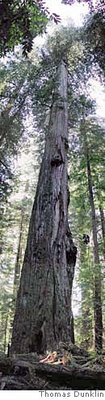
According to the Guinness Book of World Records, the 370-foot "Stratosphere Giant" in the Humboldt Redwoods State Park is the reigning world's tallest tree. However, this summer researchers in California have found not one, but three Redwood trees that exceed the current record holder! The tallest of the three new finds has been named "Hyperion" and measures 378.1 feet. Once confirmed, it is expected to take the top stop in the Guinness book.Some other interesting Tree Records:
Tallest recorded tree (non-living): Unnamed eucalyptus, 500-plus feet, recorded in 1872 in Australia
Most massive living tree: General Sherman (giant sequoia), estimated weight 4 million pounds, Sequoia National Park
Largest tree canopy: A great banyan in Calcutta's Indian Botanical Garden covers three acres.
Oldest living tree: Methuselah (Bristlecone pine), estimated 4,650 years old, California's White Mountains
Subscribe to:
Posts (Atom)