Friday, October 27, 2006

Ten-Foot Terror Bird!


The fossil of a giant carnivorous bird (2) has been found in Patagonia. It is the largest known avian skull to have ever been found.

The 10ft-tall extinct phorusrhacids (or "Terror Birds") were vicious flightless birds able to snap up dog-sized creatures that flourished in South America between 60 million and two million years ago. The find suggests that these monstrous birds, which are thought to have weighed up to half a ton, were probably more agile and less portly than previously thought.

Monday, October 23, 2006

Snowflake magnified to 300 micrometers

Thursday, October 12, 2006

Found: Mighty Mouse

Scientists have discovered what is believed to be the first terrestrial mammal found in Europe in decades: a mouse with a big head, ears, eyes and teeth that lives in a mountainous area of Cyprus.

The mouse was native to the eastern Mediterranean island, survived the arrival of man on Cyprus and could be considered a "living fossil," experts said.

The find is exciting because according to experts, "new mammal species are mainly discovered in hot spots of biodiversity like Southeast Asia, and it was generally believed that every species of mammal in Europe had been identified."

Monday, October 02, 2006

Amapa region of Brazil -- More New Species

An international team of scientists risked their lives to discover 40 new species of plants and animals in a recent exploration of the Amapa rainforest region of Brazil.

A few of the scientists were apparently "nearly eaten by hungry animals" but were ultimately able to come out of the rainforest with thousands of specimens representing dozens of new and interesting specials species. Below are some pictures from Conservation International:

"A possible new species of frog of the genus Dendrobates was discovered during recent expeditions in the Amapá Biodiversity Corridor:"


"The proposed [rainforest preservation] corridor harbors more than 1,700 species of plants and animals, including the lined forest falcon (Micrastur gilvicollis):"


Sunday, October 01, 2006

Hummingbird Close-ups

Click to enlarge these neat close-ups of hummingbirds:


Sunday, September 24, 2006

Hypoallergenic Cats

The world's first specially-bred hypoallergenic cats have gone on sale for almost $4,000 each. A biotech company was able to naturally selectively breed them by reducing a certain type of protein that triggers allergic reactions.

The company tested huge numbers of cats trying to find the tiny fraction which do not carry the glycoprotein Fel d1 - contained in their saliva, fur and skin - which produces allergies. Those cats were then used to breed the hypoallergenic cats.

According to the company, this is a "natural gene divergence within the cat DNA - one out of 50,000 cats will have this natural divergence ... so candidates of natural divergent cats were found and then bred, so there is really no modification of the gene."

Thursday, September 21, 2006

Seeds 200 years old breathe again!

The BBC reports that some seeds which have been stored away since the time of King George III have been brought to life. Scientists from the Millennium Seed Bank, operated by the Royal Botanic Gardens at Kew (near London), have induced seeds from three species to germinate. They had been brought to Britain from South Africa by a Dutch merchant in 1803, and were found in a notebook stored in the British National Archives.

The three successes are a legume, Liparia villosa, and two species not yet identified, one a protea and the other an acacia (pictured on the right).

When the plants are older, the scientists plan to compare the old plants with modern-day equivalents to determine how the species have changed and adapted over the last two centuries.

These are not the oldest seeds ever germinated. Four years ago scientists in the US germinated lotus seeds which had been carbon-dated as 500 years old; more recently, an Israeli team claimed to have grown a date palm from a 2,000 year old seed.

Wednesday, September 20, 2006

Cleanup of the Osborne "Rubber Reef"

In the 1970's, about 2 million tires covering 36 acres were dumped into the ocean off the coast of Fort Lauderdale, Florida. The site, known as "Osborne Reef," was intended to serve as a massive artificial reef that would promote marine life (listen to the NPR story here).

Unfortunately, the tires did not successfully create an artificial reef. Metal clips that held the tires together corroded, and the tires spilled across the ocean floor. Unlike sunken barges also used to build artificial reefs, the tires moved with the tide, and marine life never formed. Over the years, many of the tires have washed ashore following tropical storms and hurricanes. In addition, the movement of tires during storms has caused damage to the existing reefs.

The Florida Department of Environmental Protection, the Broward County Environmental Protection Department, and the U.S. Navy now have a pilot project in place to determine if the pile of tires can be collected and disposed of properly. It is estimated that it would take about 3 years to clean up all the tires.

How Cool are Sloths?

From Sloths.org.


Monday, September 18, 2006

New Critters from Bird's Head Seascape

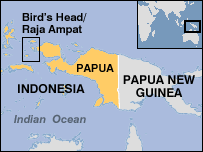
A team of scientists from Conservation International has discovered dozens of new undersea species (reports: 1, 2, 3) off the coast of Indonesia's Papua province in an area known as Bird's Head Seascape. The scientists believe the region may be the most biologically diverse in all of the oceans.

The team has claimed to have discovered 52 new species, including 24 new species of fish, 20 new species of coral and eight new species of shrimp. One of the highlights is the epaulette shark (pictured below) that walks on its fins, a praying mantis-like shrimp, and many reef-building corals.
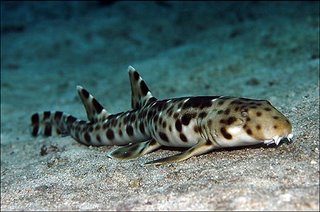


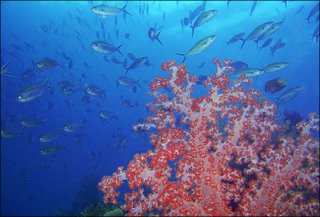
The Bird's Head region is hugely rich in diversity of fish and coral; it contains more hard coral species than Australia's Great Barrier Reef which covers an area 10 times larger. In the below picture, fish are swimming around the reef:


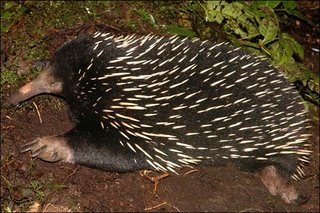
Some of the other land animals the scientists came into contact with on the expedition were unafraid of humans. Long-beaked echidnas (pictured below), primitive egg-laying mammals, were happy to be picked up:


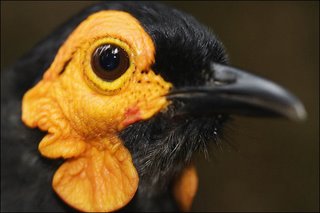
One of the highlights was the scientists' discovery of a new species of birds, including the smoky honeyeater -- the first new bird species to be sighted on the island of New Guinea in more than 60 years. The honeyeater is the black and yellow bird pictured below. Click to enlarge and check out its whiskers!
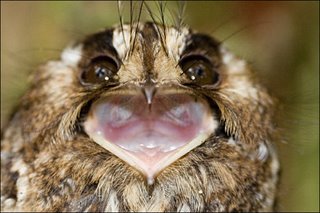


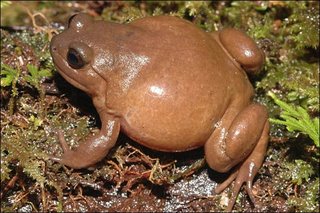
The Foja Mountains appear to be one of the richest sites for frogs in the Asia-Pacific region. More than 20 new species of frogs were found: