Friday, September 08, 2006

Tall, Tall, Trees

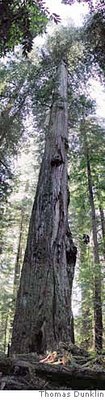
According to the Guinness Book of World Records, the 370-foot "Stratosphere Giant" in the Humboldt Redwoods State Park is the reigning world's tallest tree. However, this summer researchers in California have found not one, but three Redwood trees that exceed the current record holder! The tallest of the three new finds has been named "Hyperion" and measures 378.1 feet. Once confirmed, it is expected to take the top stop in the Guinness book.

Some other interesting Tree Records:

Tallest recorded tree (non-living): Unnamed eucalyptus, 500-plus feet, recorded in 1872 in Australia

Most massive living tree: General Sherman (giant sequoia), estimated weight 4 million pounds, Sequoia National Park

Largest tree canopy: A great banyan in Calcutta's Indian Botanical Garden covers three acres.

Oldest living tree: Methuselah (Bristlecone pine), estimated 4,650 years old, California's White Mountains

Mice don't like cheese!

Researchers have found that contrary to popular belief, mice don’t actually like cheese. The scientists instead note that mice prefer foods with high sugar content like grains and fruit and would not eat something as strong in smell and rich in taste as cheese. Cheese is not something that would be available in their natural environment.

Wednesday, September 06, 2006

Ultra-Energy-Efficient House

BusinessWeek has an article on an ultra-energy-efficient house in Santa Monica, CA which is the first home in the country to be given "platinum" status in the U.S. Green Building Council's LEED rating system (for Leadership in Energy and Environmental Design).

Some of the neat, energy-saving features of this environmentally-friendly house include:

- Living Roof: A garden of deer grass and other native plants will help insulate the house, keeping it cooler in the summer and retaining heat in the winter.

- Hot Water: A panel of glass tubes is positioned on the roof. Water pumped through the tubes is heated by the sun and stored in an insulated tank for use in showers and sinks. Hot water is also circulated through a series of plastic tubes embedded in the house's floors. This radiant heating system is more energy-efficient than forced air and doesn't spread pollen, dust, or germs.

- Recycled Water: Rainwater collected from the roof and yard is stored in a cistern buried under the house. So-called "gray water" from the sinks and showers is run through an underground filtration system consisting of asphalt, rock, and soil. Both sources are used to water the rooftop garden and grounds.

Be sure to check out the accompanying graphic and slideshow!


Saturday, September 02, 2006

Animation of Life Inside a Cell

Harvard University has decided to use animations as a tool to enhance the performance of its students in biology. A company called XVIVO has produced the animations for the university. One entitled "The Inner Life of the Cell" has already won awards. The animation takes students on a three-dimensional journey through the microscopic world of a cell. Below is a 3 minute sample of the movie:


Thanks to Slashdot for the link.

Update:
Here is a link to a Wired News article that includes further information on the video, including an interview with its creator.

Monday, August 21, 2006

Oil Spill Along the Lebanese Coast

The NASA Earth Observatory has posted satellite pictures of a major oil spill which has resulted from the recent conflict between Israel and Lebanon (click on the picture below for a full size image). In the image, the oil slick appears as a slightly darker shade of blue on the ocean surface, and it is easier to see in the enlarged area around Beirut at lower right. The slick spreads from the power plant at the southern end of the image to well north of the city of Beirut.

The spill resulted from an attack on the Jiyyeh Power Station. According to BBC news, early estimates indicated that the oil spill could rival the Exxon Valdez accident in 1989. Covering roughly 120 kilometers (75 miles), the spill is expected to affect fishing and tourism industries, as well as local wildlife.


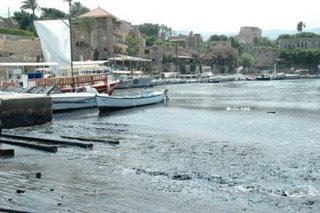
The below picture shows some of the oil-polluted water washing into the harbor of Byblos in Lebanon:


The environmental effects of spilled oil can vary depending upon the type and amount of material that is spilled. In general, lighter refined petroleum products such as diesel and gasoline are more likely to mix in the water column and are more toxic to marine life, but tend to evaporate relatively quickly and do not persist long in the environment. Heavier crude or fuel oil, while of less immediate toxicity, can remain on the water surface or stranded on the shoreline for much longer. Oil from the Exxon Valdez and Gulf War oil spills, while weathering over time, has persisted along the shoreline for years after the spill.

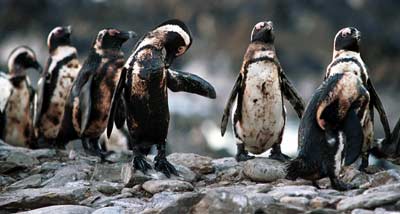
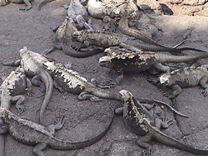
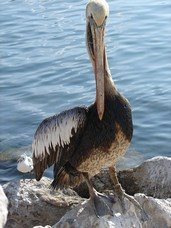
The following pictures show some of the unfortunage effects of oil spills on wildlife, as well as the arduous cleanup process. Also, be sure to check out this link that maps major oil spills since 1960.


Wednesday, August 16, 2006

Sounds of the Lyrebird

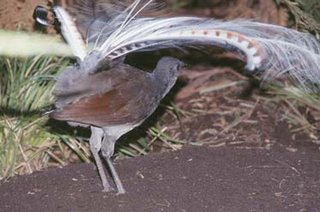
The below video on Lyrebirds highlights their amazing ability to mimic all sorts of sounds. As seen in the video, the birds can even mimic human sounds such as car alarms, chainsaws, and cameras. Lyrebirds are among Australia's best-known native birds, even though they are rarely seen in their natural habitat. In addition to their extraordinary mimicking ability, lyrebirds are notable because of the striking beauty of the male bird's huge tail when it is fanned out in a courtship display.


The below picture of a male Lyrebird is from the Museum Victoria:

Saturday, August 12, 2006

Walking Bats and Duplicitous Octopi

Here are some cool blog posts (1, 2) about interesting methods of octopi camouflage:


and walking vampire bats:


Be sure to check out the videos at both sites!

Bonnie The Mutt


Ashes and Show

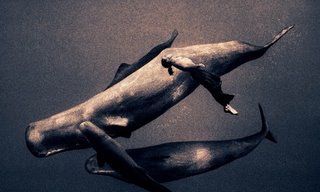
Gregory Colbert has spent over a decade creating a fascinating exhibition of photos and videos entitled Ashes and Snow. The pieces feature wild animals and humans interacting in amazing ways. The pictures have not been digitally collaged or superimposed in any way. Below are two photographs from the exhibition. The second picture features the artist himself.


Underwater Volcanic Eruption

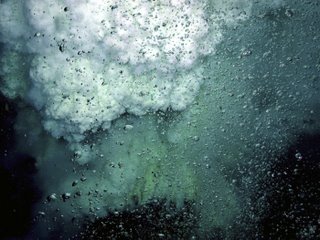
The NOAA has some interesting coverage of a long-term deep-sea volcanic eruption that was first discovered in 2004 on the Mariana Arc. Check out videos of the eruption here and here. (via CNET).